Best Non-Contact Voltage Tester 2026: Top 5 Safety Testers Compared
A non-contact voltage tester is the first tool you grab before touching any wire. It tells you whether a circuit is live — and getting this wrong can be fatal. This guide compares the best non-contact voltage testers for solar installers and electricians in 2026, by detection range, voltage range, safety rating, and convenience features. It does not teach electrical safety procedures.
VP
By Vopace Research DeskUpdated June 28, 2026 | Non-contact voltage tester comparison
Affiliate Disclosure: As an Amazon Associate, Vopace earns from qualifying purchases. This page may contain affiliate links.
Guide, Not Instruction: This page helps you choose a voltage tester. It does not teach electrical safety, troubleshooting, or wiring procedures. Always read the manufacturer manual and hire a qualified electrician for any electrical work.
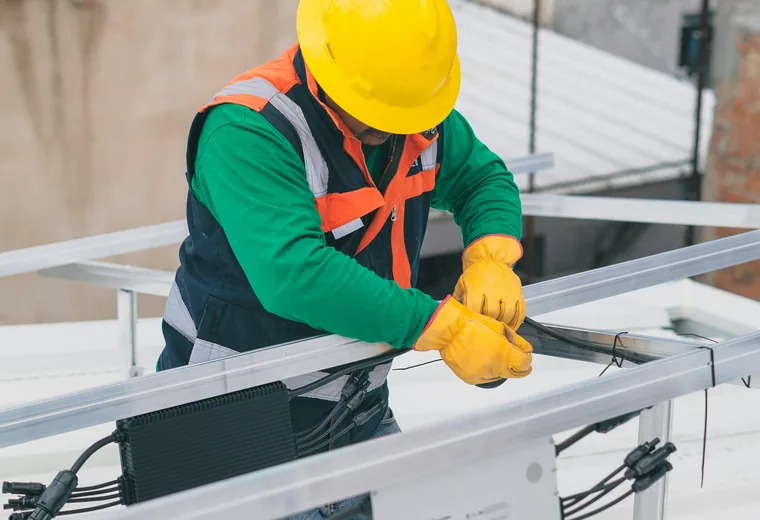
Non-contact voltage tester in use near an electrical panel. Image for tool identification reference only.
Quick picks: Best non-contact voltage testers of 2026
Best overall: Digital display non-contact voltage tester — shows actual voltage level, auto-sensing, and works on AC/DC.
Best for solar PV: High-voltage 1000V DC non-contact tester — designed for solar array work, detects dangerous DC voltages standard testers miss.
Best budget: Neon standard non-contact voltage tester — no batteries required, simple and reliable for basic AC presence checks.
Best for professionals: Pro dual-mode voltage tester — combines touch-sensing and distance detection for maximum versatility on the job site.
Best backup: Keychain non-contact voltage tester — ultra-compact, always accessible, perfect as a secondary or emergency tester.
Detailed reviews: Top 5 non-contact voltage testers
Below we review each category in detail, covering specifications, detection performance, build quality, and real-world use cases. Every product link goes to Amazon where you can compare current pricing and customer reviews.
Overall Pick
Digital Display Non-Contact Voltage Tester
The digital display non-contact voltage tester is the workhorse for daily professional use. Unlike basic LED-only testers, this model shows the actual measured voltage on an LCD screen — typically 12V, 24V, 48V, 110–125V, 220–250V, or higher depending on the model. This eliminates guesswork and gives you confidence that the reading is accurate before you proceed with any work.
Technical Specifications
Most quality digital display models cover AC voltage ranges from 12V to 600V and some extend to 1000V for DC detection. Detection distance typically reaches 10mm to 25mm through insulation, allowing you to test wires without stripping them. The LCD backlight enables readings in dark electrical panels or under solar arrays at night. Battery life usually spans 1,000 to 2,000 hours of continuous use on a single CR2032 coin cell. Many models include a built-in continuity tester and a sound alarm that activates alongside the visual display.
Use Cases
This tester excels in residential electrical panel inspections, commercial wiring verification, and solar DC string testing. Solar installers particularly benefit from the digital readout when confirming voltage levels on PV strings before connecting to inverters. Electricians appreciate the ability to quickly distinguish between 120V and 240V circuits without removing wire insulation. Homeowners use it for basic outlet and circuit breaker checks during DIY projects.
Why It Stands Out
The combination of voltage level readout and audio alert creates a redundant confirmation system. If the battery is dying, most models trigger a low-battery icon on the display. The auto-sensing mode detects voltage from up to 25mm away, which is critical when working in cramped junction boxes or behind dense conduit runs. Look for models with CAT III 600V or CAT IV 300V safety ratings for maximum protection.
Solar PV arrays produce direct current at voltages that can exceed 1,000V under open-circuit conditions. Standard 600V AC-only testers will not detect these voltages, leaving solar installers dangerously unaware of live conductors. The high-voltage 1000V DC non-contact voltage tester is purpose-built for this environment and is essential equipment for anyone working on solar installations.
Technical Specifications
These testers typically handle AC voltage from 12V to 600V and DC voltage from 12V to 1,000V. Detection distance ranges from 10mm to 20mm, optimized for insulated PV wire types such as USE-2 and TBS cable. The alarm is usually a loud piezo buzzer rated above 85dB, audible over job-site noise. Many models include a dedicated DC detection mode switch to reduce false AC triggers. Battery life averages 800 to 1,500 hours. Some premium models feature a large digital display showing exact DC voltage levels, similar to the overall pick but with extended DC range.
Use Cases
Primary application is solar PV array commissioning and maintenance. When troubleshooting string configurations, verifying MC4 connector polarity, or checking combiner box outputs, this tester confirms whether dangerous DC voltages are present. It is equally valuable for commercial rooftop solar farms, ground-mount residential systems, and off-grid solar installations with battery banks. Electrical inspectors reviewing solar permits often require proof of DC voltage detection capability.
Why It Stands Out
The ability to detect high-voltage DC is the defining feature. Standard neon testers and basic LED models simply cannot sense DC fields at all. Without this capability, a solar installer might assume a PV string is de-energized when it is actually producing 800V+ DC — a potentially lethal condition. Look for models with NRTL certification (ETL or UL listed) for solar applications, as this ensures the tester itself meets safety standards for the voltages it claims to detect.
The neon-style non-contact voltage tester represents the simplest and most affordable category of voltage detection tools. It contains no batteries, no LCD display, and no circuitry beyond a neon lamp and a high-impedance sensing tip. When brought near an AC electric field, the neon bulb glows with intensity proportional to the field strength. This simplicity makes it nearly indestructible and extremely cost-effective for basic presence-check tasks.
Technical Specifications
Standard neon testers cover AC voltage ranges from 90V to 600V. They do not detect DC voltage at all — the neon lamp requires alternating current to fire. Detection distance is typically limited to 5mm to 15mm, meaning the sensing tip must be closer to the conductor than digital models. The neon glow serves as both visual indicator and the sole feedback mechanism. No batteries means zero maintenance cost over the tool's lifespan, though the neon bulb itself has a finite operational life measured in tens of thousands of activations. The form factor is usually pen-shaped for easy handling.
Use Cases
Ideal for quick AC presence checks in household outlets, circuit breakers, and extension cords. Handy for homeowners doing basic troubleshooting like confirming a switched outlet is powered. Electricians use them as a fast secondary verification tool alongside more sophisticated testers. Not suitable for solar PV work since they cannot detect DC voltage. Also inadequate for low-voltage systems below 90V AC, such as 24V control circuits or 12V lighting systems.
Why It Stands Out
The absence of batteries is both its greatest strength and its limitation. You never need to worry about a dead battery rendering the tool useless in an emergency. The cost is typically a fraction of digital models, making it easy to stock spares on every job truck. The pen-style form factor slips into any pocket or tool pouch. However, the reliance on neon glow means readings are qualitative rather than quantitative — you can tell voltage is present, but not how much.
The professional dual-mode voltage tester combines two detection methods in a single tool: proximity (distance) sensing and touch sensing. In proximity mode, the tester alarms when brought near a live conductor without physical contact — ideal for safely scanning cables, checking outlet boxes, and working on energized panels. In touch mode, you press the tip against the wire or terminal to confirm voltage through direct contact, which increases sensitivity and reduces false triggers from nearby electromagnetic interference.
Technical Specifications
Dual-mode testers typically cover AC voltage from 12V to 600V and some include DC detection up to 200V or higher. The proximity detection distance reaches up to 50mm in some models, significantly farther than standard testers. Touch mode extends sensitivity down to lower voltage thresholds. Audio feedback varies by mode — proximity mode often uses a vibrating motor plus audible alarm, while touch mode provides a distinct tone pattern. Many include a temperature sensor for checking hot connections. Display ranges from a single LED bar graph to a full numeric LCD. Battery life typically spans 1,500 to 3,000 hours with auto-shutoff after 30 minutes of inactivity.
Use Cases
Professional electricians rely on dual-mode testers for complex commercial wiring, industrial control panels, and HVAC installations where distinguishing between induced voltage and true live voltage is critical. The touch mode helps eliminate false positives from capacitive coupling in densely packed conduit runs. Solar technicians use the proximity mode for safe scanning of MC4 connectors and junction boxes without touching exposed terminals. Home inspectors find the vibration-only mode useful for quiet environments like occupied homes during evening inspections.
Why It Stands Out
The dual-mode capability addresses the single biggest complaint about non-contact testers: false triggers from nearby energized conductors. When you run a non-contact tester along a cable tray with multiple live wires, proximity mode alone may alarm on every conductor. Switching to touch mode narrows the sensing area dramatically, letting you pinpoint the exact wire that is live. This precision saves time and prevents misdiagnosis on complex jobs. The integrated temperature sensor adds diagnostic value beyond simple voltage detection.
Dual proximity and touch modes reduce false triggers
Compact keychain voltage testers are great for quick checks and always being on hand. No need to reach into a tool bag. Simple beep-and-light indication. Not suitable as your primary tester for solar installations, but useful as a backup or for quick home checks.
Technical Specifications
Keychain testers typically cover AC voltage from 12V to 600V with a detection distance of 3mm to 10mm. The sensing element is a small piezo buzzer and a red LED mounted on a PCB no larger than a thumb. Power comes from a single AAA or button cell battery, lasting 500 to 1,000 hours. The entire unit weighs 15 to 30 grams and fits on a keyring alongside your house and car keys. Some models include a small belt clip instead of a keyring hole. The form factor prioritizes portability over precision — expect a 5mm to 10mm tolerance on detection distance.
Use Cases
Perfect for homeowners who want a voltage checker always within arm's reach. Check if a lamp socket is live before changing a bulb. Verify that a GFCI outlet has tripped correctly. Confirm whether a circuit breaker is on or off without opening the panel. Contractors keep one in the truck glove box for unexpected service calls. Not recommended as the sole tester for professional electrical work due to limited sensitivity and lack of voltage level indication. Ideal as a secondary or tertiary backup alongside your primary digital tester.
Why It Stands Out
The keychain form factor guarantees accessibility. You cannot forget a tool that hangs on your keys every day. The low cost means you can buy multiple units and distribute them across vehicles, homes, and workboxes. Despite the small size, modern keychain testers use sensitive CMOS input stages that can detect voltage through thin drywall and light plastic covers. The simple beep-and-light feedback is fast and intuitive — no menus, no mode switches, no learning curve.
The table below summarizes the key specifications for each non-contact voltage tester category. Use it to quickly identify which model fits your application — whether you are wiring a residential panel, commissioning a solar array, or doing quick home checks.
Safety RatingCAT III 600VCAT III 600V / CAT IV 300VBasicCAT IV 600VBasic
Special FeaturesContinuity, backlightAC/DC mode switchPen-shapedTouch mode, temp sensorKeychain clip
Best ApplicationDaily professional useSolar PV arraysBasic AC checksComplex commercial wiringQuick backup checks
Price Range–––––
Buying guide: How to choose the right non-contact voltage tester
Selecting the right non-contact voltage tester depends on your specific use case, the voltage environments you work in, and the level of diagnostic information you need. Follow these criteria to narrow down your options and invest in a tool that matches your actual requirements rather than over-buying or under-buying.
1. Determine your voltage environment
Start by identifying the highest voltage you will encounter. Residential 120V/240V AC work requires a different tester than a commercial 480V three-phase panel or a solar PV array producing 800V+ DC. If you only work on standard household circuits, a basic 600V AC tester is sufficient. If you install or maintain solar arrays, a 1000V DC-capable model is non-negotiable for safety. Mismatching the tester to the voltage environment is one of the most common and dangerous mistakes in the field.
2. AC-only versus AC/DC dual detection
The vast majority of inexpensive non-contact testers detect only AC voltage. This is fine for standard household and commercial AC wiring but completely inadequate for solar PV, battery storage systems, and DC-powered equipment. If your work involves any DC circuits — solar panels, charge controllers, battery banks, DC lighting, or EV charging stations — choose a tester explicitly rated for DC detection. Verify this in the product specifications; many sellers only advertise AC range in the title.
3. Digital display versus LED-only versus neon
Digital display models show the approximate voltage level on an LCD screen, which provides quantitative data beyond a simple presence check. LED-bar models give a rough visual estimate through the number of illuminated segments. Neon and basic LED-only testers only indicate presence or absence with no magnitude information. For professional work where you need to distinguish between 120V and 240V, or verify that a DC string is producing the expected voltage, digital or LED-bar models are strongly preferred. For simple yes/no checks, the cheaper options suffice.
4. Detection range and sensitivity
Detection range determines how far the sensing tip can be from the conductor and still register voltage. Standard testers reach 10mm to 25mm. Professional dual-mode models can extend to 50mm in proximity mode. Greater range is advantageous when testing thick-insulated cables, wires behind drywall, or conductors inside conduit. However, excessive range can increase susceptibility to false triggers from nearby live conductors. Balance range with your working environment: tight conduit bundles benefit from shorter range and touch mode, while open wiring benefits from longer range.
5. Safety certification and rating
Look for testers certified by recognized laboratories such as UL, ETL, or TUV. The safety rating (CAT III, CAT IV) indicates the maximum transient overvoltage the tester can withstand. CAT IV is the highest rating and is required for work at the service entrance or utility connection point. CAT III is appropriate for distribution-level work such as commercial panels. Basic non-certified testers may be adequate for low-risk household use but should not be relied upon in industrial or utility environments.
6. Additional features that matter
Consider features that add practical value on the job site. A backlit LCD is essential for dark electrical panels and nighttime solar work. Built-in continuity testing turns the device into a two-in-one tool. Temperature sensors help identify hot connections that may indicate loose wiring or overloaded circuits. Vibration-only alert mode is useful for quiet environments like occupied homes or library renovations. Auto-shutoff preserves battery life during long shifts. Self-test functionality verifies the alarm circuit before each use.
7. Build quality and ergonomics
The tester will spend most of its life in your pocket, tool bag, or clipped to a harness. Choose a model with a durable polycarbonate or rubberized housing that survives drops from ladder height. The grip should be comfortable for extended one-handed use. A belt clip or lanyard hole adds convenience. Weight matters less for occasional use but accumulates fatigue over a full workday on large solar installations where you carry the tester for eight hours straight.
8. Battery type and availability
Common battery types include CR2032 coin cells, AAA alkaline, AA rechargeable, and built-in lithium. Coin cells are inexpensive and widely available but offer shorter runtime. AAA alkalines last longer but add bulk. Rechargeable built-in lithium batteries eliminate ongoing replacement costs but require a USB cable for charging. Consider your supply chain: if you work in remote solar sites far from stores, a tester using common AAA batteries is more practical than one requiring a specific coin cell.
What a non-contact voltage tester can and cannot tell you
Understanding the limitations of non-contact voltage testers is as important as knowing what they do. These tools are designed for one primary function: detecting the presence of an electric field near a conductor. They are not comprehensive diagnostic instruments. Misunderstanding their capabilities can lead to incorrect conclusions about circuit status, which in turn can create serious safety hazards.
What it CAN tell you
A non-contact voltage tester reliably tells you whether an electric field is present near a conductor. This means you can confirm that a wire or terminal is live, that a circuit breaker is supplying power, or that a solar string is producing voltage. The audio alarm and LED indicators provide immediate feedback without requiring physical contact with the conductor. Digital display models additionally tell you the approximate voltage level within predefined ranges (e.g., 12V, 110V, 220V). This information is sufficient for most safety verification tasks before beginning electrical work.
What it CANNOT tell you
A non-contact tester does not measure exact voltage — the LCD readout shows approximate ranges, not precise values. It cannot determine current flow, resistance, power factor, or waveform quality. It cannot verify that a circuit is de-energized with certainty, because low-voltage leakage, induced voltage from adjacent conductors, or a dying battery in the tester itself can produce false readings. It cannot replace a multimeter for troubleshooting electrical faults. It cannot confirm wire continuity or identify which specific conductor in a multi-wire cable is live without some ambiguity. And critically, it cannot protect you from electrical shock on its own — it is a detection tool, not a personal protective equipment device.
False positive and false negative scenarios
False positives occur when the tester alarms on a wire that is not actually live. Common causes include induced voltage from a nearby energized conductor running parallel in the same conduit or cable, capacitive coupling in densely packed junction boxes, and static electricity buildup on the tester tip. If you encounter a false positive, switch to touch mode (if available) or verify with a multimeter. False negatives occur when the tester fails to detect a live conductor. This happens when the insulation is exceptionally thick, the tester battery is depleted, the voltage is below the minimum detection threshold, or the conductor is shielded by metal conduit. Always verify with a known live source before trusting a null reading.
When to use a multimeter instead
Non-contact testers are your first line of defense for quick live/dead checks. But when you need to troubleshoot why a circuit is not working, measure exact voltage under load, check continuity between two points, or verify phase rotation, a digital multimeter is the appropriate instrument. Think of the non-contact tester as a rapid screening tool and the multimeter as the precision diagnostic tool. Professional electricians carry both and use them complementarily, not interchangeably.
Use cases by environment: Where different testers excel
Different work environments impose different requirements on voltage detection tools. The tester that is perfect for a residential electrical panel may be inadequate for a commercial solar farm. Below we break down the optimal tester choice for three common environments and explain why.
Solar PV array installations
Solar PV arrays operate at dangerously high DC voltages. A typical residential 6kW system with 24 panels in series can produce 600V to 800V DC under full sunlight. Commercial installations with multiple strings in series can exceed 1,000V DC. Standard AC-only non-contact testers will not detect these voltages at all, creating a false sense of security. For solar work, a high-voltage DC-capable tester with at least 1000V DC rating is mandatory. Digital display models with both AC and DC detection provide the most flexibility for commissioning work, where you need to verify both the PV string voltage and the inverter AC output. Detection distance of at least 15mm is recommended because PV wire insulation is thicker than standard building wire.
Residential and commercial electrical panels
Electrical panel work involves AC voltages from 120V to 480V depending on the building type. The primary need is rapid confirmation of which breakers are live and which circuits are energized. A digital display non-contact voltage tester with CAT III 600V or CAT IV 300V rating is the standard choice. The digital readout helps distinguish between 120V branch circuits and 240V appliance circuits without opening the panel cover fully. A detection range of 15mm to 25mm allows scanning bus bars through panel gaps. The built-in continuity function is useful for verifying breaker trip status. For panel work, a dual-mode tester is advantageous because it reduces false triggers from adjacent live bus bars in densely packed panels.
Homeowner and DIY use
Homeowners typically need to verify whether outlets are powered, whether a light fixture is live before replacing a bulb, or whether a GFCI has tripped. A basic neon or LED-only tester is often sufficient for these tasks. Keychain testers are particularly popular because they are always accessible and cost little enough to keep in multiple locations. For homeowners who also have solar panels, EV chargers, or battery storage systems, upgrading to a DC-capable digital model is advisable. The cost difference of to is minor compared to the safety benefit of having a tester that covers both AC and DC.
Industrial and HVAC applications
Industrial environments often involve 480V three-phase AC, motor control circuits, and variable frequency drives that generate electromagnetic noise. This noise can cause standard non-contact testers to produce false alarms. A professional dual-mode tester with touch mode is strongly recommended because the touch mode narrows the sensing zone and reduces susceptibility to ambient electromagnetic interference. Built-in temperature sensors are valuable for identifying overheated connections in motor starters and contactors. Vibration-only alert mode prevents disturbing workers in active manufacturing facilities. CAT IV 600V safety rating is the minimum standard for industrial panel work.
Maintenance and storage tips for voltage testers
A voltage tester is a safety-critical tool. Its reliability directly impacts your ability to work safely around live circuits. Proper maintenance and storage extend the tool's lifespan and ensure it performs correctly when you need it most. Follow these practices to keep your non-contact voltage tester in reliable condition.
Battery management
Replace batteries promptly when the low-battery indicator appears or when detection range noticeably decreases. Do not mix old and new batteries. Store spare batteries separately from the tester to prevent accidental discharge. For testers with built-in rechargeable batteries, follow the manufacturer's charging cycle recommendations and avoid deep discharge cycles that can degrade lithium cell capacity over time. Before each major job, verify the tester works by pressing the self-test button or touching it to a known live source.
Physical inspection routine
Inspect the tester housing before every use for cracks, missing screws, or damaged sensing tips. A compromised housing can allow moisture ingress or reduce dielectric strength, defeating the safety rating. Check the LCD screen for dead pixels or dimming that may indicate battery depletion. Verify that the audio alarm is audible and at sufficient volume. Clean the sensing tip with a dry cloth to remove dirt, grease, or oxidation that can reduce detection sensitivity. Do not use solvents or abrasive cleaners on the housing.
Storage conditions
Store testers in a dry, temperature-controlled environment. Extreme heat degrades battery life and can warp plastic housings. Extreme cold reduces battery output and may temporarily decrease detection sensitivity. Keep testers away from strong magnetic fields and high-voltage sources when not in use, as prolonged exposure can affect internal calibration. Use a dedicated pouch or compartment in your tool bag to prevent the sensing tip from contacting metal objects that could cause damage or short circuits.
Calibration and verification
While non-contact voltage testers do not require formal calibration like precision multimeters, periodic verification against a known voltage source is good practice. Test your device on a circuit or outlet you know is live at least once per month. If the tester fails to detect the known voltage, replace the battery first, and if the problem persists, replace the unit. Never trust a tester that has failed a verification check. Document your verification dates for records, especially in commercial or industrial settings where tool accountability is required.
Frequently asked questions about non-contact voltage testers
Can a non-contact voltage tester detect DC voltage?
It depends on the model. Standard and budget non-contact testers detect only AC voltage. Models specifically designed for solar PV work or labeled as AC/DC dual-mode testers can detect both AC and DC voltage. If you work with solar panels, battery systems, or any DC-powered equipment, you must choose a tester explicitly rated for DC detection. Check the product specifications for a DC voltage range listing — if it is absent, the tester does not detect DC.
How far away can a non-contact voltage tester detect voltage?
Detection distance varies by model and environment. Basic LED testers typically detect from 3mm to 10mm away. Digital display models usually reach 10mm to 25mm. Professional dual-mode testers in proximity mode can detect from up to 50mm. Thicker wire insulation, conduit material, and ambient electromagnetic interference all affect the effective detection distance. Always hold the sensing tip as close as safely possible to the conductor for the most reliable reading.
Is a non-contact voltage tester safe to use on live circuits?
Non-contact voltage testers are designed for safe voltage detection without physical contact with live conductors, which is their primary advantage over contact-based testers. However, they are not personal protective equipment. They do not protect you from shock — they alert you to the presence of voltage. Always treat every circuit as potentially live until verified otherwise with a known-good source. Use a tester rated for the voltage and safety category (CAT III/CAT IV) of the environment you are working in. Never rely solely on a non-contact tester to confirm a circuit is dead before touching it.
Why does my non-contact tester alarm when I bring it near a wire that I think is off?
This is usually caused by one of three conditions: induced voltage from an adjacent live conductor running in the same cable or conduit, residual capacitance in a recently de-energized circuit, or a faulty wire connection creating a leakage field. In residential wiring, it is common for a switched-off circuit to still induce voltage from the nearby hot conductor in the same Romex cable. If you suspect a false trigger, switch to touch mode (if your tester supports it) or verify with a multimeter. If the tester alarms consistently on a circuit you are certain is de-energized, replace the battery and retest.
Can I use a non-contact voltage tester to find a broken wire inside a wall?
Yes, to some extent. Many digital non-contact testers can trace live wires through drywall and light plaster using their proximity sensing capability. Move the tester slowly along the wall surface where the wire runs. The alarm will be strongest directly above the live conductor and weaken or disappear where the wire is broken or disconnected. This technique works best on AC circuits at standard line voltages (120V/240V). It is less effective on low-voltage DC circuits or heavily shielded cables. For precise fault location, a dedicated cable tracer tool is more reliable.
How often should I replace my non-contact voltage tester?
There is no fixed replacement schedule. Replace your tester when it fails verification against a known live source after battery replacement, when the housing is cracked or damaged, or when the LCD display becomes unreadable. Quality digital testers typically last three to five years with regular use. Budget models may need replacement sooner. Industrial testers subjected to drops, extreme temperatures, and constant use may show wear within one to two years. Keep a spare tester at all times so you are never without a voltage checker.
Do I need a UL or ETL certified voltage tester?
For professional electrical work in commercial or industrial settings, UL or ETL certification is strongly recommended and often required by workplace safety regulations. Certification verifies that the tester meets published safety standards for voltage range, dielectric strength, and drop resistance. For basic homeowner use in residential settings, uncertified testers are commonly used, but certified models provide an extra margin of safety and are worth the modest price premium. Solar installers should always use certified testers, as many jurisdictions require documented safety certification for equipment used on PV installations.
What is the difference between a non-contact tester and a voltage multimeter?
A non-contact voltage tester detects the presence of an electric field without touching the conductor, providing a quick yes-or-no answer about whether voltage is present. A multimeter requires physical contact with the conductor through probes and provides a precise numerical voltage reading, resistance measurement, continuity check, and sometimes additional parameters like frequency and capacitance. Use a non-contact tester for rapid safety verification and a multimeter for detailed diagnostics and troubleshooting. They serve complementary roles, not competing ones.
Safety Note: This page is a buying guide, not a safety procedure. Non-contact testers are for selecting and purchasing the right tool. Always verify with a known live source before relying on any tester reading. Consult a qualified electrician for electrical safety procedures and always follow OSHA and NEC requirements for your jurisdiction.