True RMS Digital Multimeter with CAT III 1000V
True RMS multimeters with CAT III 1000V safety ratings are the top choice for solar installers working with high-voltage DC PV arrays. True RMS provides accurate readings on non-sinusoidal waveforms, which matters when testing inverters and grid-tied systems alongside pure DC panel strings. Key features to compare: auto-ranging, temperature measurement, relative mode, and solar-specific functions like open-circuit voltage testing.
This category of multimeter handles the full range of solar installation tasks. On a typical residential rooftop job, you will measure DC voltage from panel strings (often 300–700V Voc), check AC output from microinverters or string inverters, verify grounding continuity, and test resistance in wiring connections. A CAT III 1000V rating means the meter is protected against voltage transients up to 1000V in fixed installations, which covers most commercial solar array configurations. The True RMS function ensures accurate readings even when dealing with modified sine wave outputs from some inverters during commissioning tests.
Look for models with a minimum DC voltage range of 1000V, AC voltage up to 1000V, current measurement up to 10A or 20A, and resistance up to 40MΩ or higher. Auto-ranging saves valuable time when moving between different panel strings with varying voltages. A backlit display with large digits is essential for reading measurements under direct sunlight on a rooftop. Many professional-grade meters in this category offer IP67 or IP64 ingress protection, meaning they can withstand dust, rain, and accidental drops from ladder height.
Battery life is another critical factor. Solar installers typically work 8–12 hours per day on rooftops. A quality True RMS multimeter should deliver at least 200 hours of continuous operation on a single 9V battery, with auto-power-off as a backup. Some models include USB connectivity for firmware updates and data transfer to diagnostic software used in commissioning reports.
- True RMS for accurate readings
- CAT III 1000V safety rated
- Auto-ranging saves time on site
- Handles both DC and AC measurements
- Large backlit display for outdoor use
- Higher price point (–)
- Heavier than compact meters
- Larger display needed for readability
Auto-Ranging Solar Multimeter with Temperature
Auto-ranging multimeters designed for solar applications include temperature measurement probes and open-circuit voltage testing. The auto-ranging feature means you never have to manually select voltage ranges when checking multiple PV panel strings. Look for high DC voltage range, data hold, and temperature accuracy.
This type of multimeter excels in solar array testing environments where speed and convenience matter. When you are checking 20 or more panel strings on a commercial installation, manually switching range settings wastes time and increases the risk of measurement errors. An auto-ranging meter detects the voltage level automatically and switches to the appropriate measurement range within milliseconds. Many models in this category include a dedicated temperature measurement function using a K-type thermocouple probe, which is useful for checking junction box temperatures, monitoring inverter cooling, and verifying that panel connections are not overheating due to high resistance.
The temperature measurement capability is particularly valuable for commissioning and quality assurance. A temperature differential of more than 10°C between connected panels in the same string can indicate a faulty connection, damaged cell, or shading issue. Some advanced auto-ranging meters also include frequency measurement, which helps verify that grid-tied inverters are operating at the correct line frequency (50Hz or 60Hz depending on region).
For solar-specific work, ensure the DC voltage range covers at least 600V, with 1000V being preferable for modern high-voltage string configurations. Accuracy of 0.5% or better on DC voltage measurements is recommended for reliable panel string testing. Models with a relative mode allow you to zero out the display for precise millivolt-level differential measurements, useful for detecting small voltage drops across connections.
- No manual range switching on site
- Built-in temperature measurement
- Optimized for PV panel testing
- Frequency measurement on some models
- Relative mode for differential readings
- May lack some advanced features
- Requires temperature probe cable management
- Auto-ranging can be slightly slower on rapid voltage changes
Compact Digital Multimeter for Field Use
Compact multimeters are ideal for solar installers who need a lightweight secondary meter for quick checks. Small form factor fits in tool pockets. Despite the size, look for CAT III 600V minimum rating, True RMS, and a large enough display for outdoor readability.
Solar installers frequently carry multiple tools on a rooftop, and every ounce matters when climbing ladders and navigating panel arrays. A compact multimeter typically weighs between 150–300 grams, compared to 400–600 grams for full-size professional meters. The smaller footprint also means it fits more easily into tool belt pockets, side bags, and the limited space of a roof-mounted electrical panel. Many compact models include a built-in probe holder or clip-on design that keeps test leads organized and prevents them from dangling while working at height.
Despite their smaller size, modern compact multimeters have improved significantly. Many now include True RMS measurement, auto-ranging, and CAT III 600V safety ratings that are adequate for most residential solar installations. The main trade-off is display size and maximum voltage rating. If your work primarily involves residential systems with string voltages below 600V DC, a compact meter is an excellent primary or backup tool. For commercial installations with higher voltages, consider a full-size CAT III 1000V model instead.
Look for compact meters with a minimum DC voltage range of 600V, current measurement up to 10A, and a display that is readable in direct sunlight. Some models feature a flip-out kickstand or magnetic back for hands-free operation when placed near electrical panels. Battery life on compact meters tends to be shorter due to smaller internal batteries, so check for low-battery indicators and replaceable battery options.
- Lightweight and pocket-friendly
- Good for quick field checks
- Often includes probe storage
- Fits easily in tool belts
- Great as a secondary backup meter
- Smaller display harder to read in sun
- Lower max voltage rating (usually 600V)
- Shorter battery life
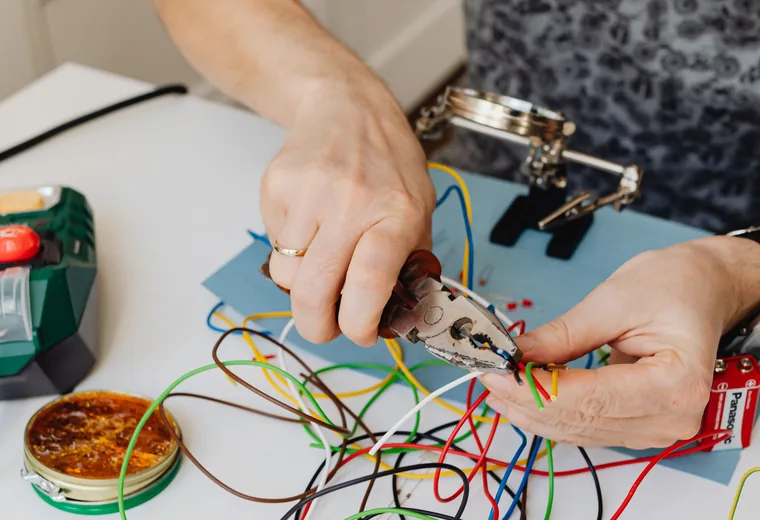
Essential Digital Multimeter
Essential multimeters cover the basics – voltage, current, resistance, continuity – at an affordable price. Suitable for solar installers on a budget or for homeowners with small PV systems. Ensure the safety rating meets your system voltage and check that the DC voltage range covers your panel string output.
Not every solar installer needs a premium True RMS meter with advanced data logging. For beginners, hobbyists, or those working on small residential systems (under 5kW with string voltages below 400V), an essential multimeter provides the core functionality needed for most solar installation tasks. These meters typically feature manual ranging, which means you select the measurement range yourself, but they are simpler to use and significantly more affordable.
When shopping for an essential multimeter for solar work, the most important specification is the DC voltage range. Make sure it can handle the open-circuit voltage (Voc) of your panel strings. A typical 60-cell monocrystalline panel has a Voc of around 38–45V, and a string of 15–20 panels in series can reach 600–900V DC. Some budget meters top out at 600V DC, which may be insufficient for larger residential or commercial arrays. Look for models rated to at least 1000V DC if you plan to work on systems beyond small rooftop setups.
Other essential features include audible continuity testing for verifying wire connections, a diode test mode for checking panel bypass diodes, and a minimum CAT III 600V safety rating. Many essential meters also include a hold button to freeze readings for easier note-taking, and a range hold function for stable measurements in electrically noisy environments near inverters.
- Affordable price point (–)
- Covers essential measurements
- Good for small systems
- Simple to learn and use
- Lightweight for travel
- May not handle 1000V DC
- Manual ranging requires experience
- Fewer safety features than premium models
Multimeter with Data Logging
Data logging multimeters record measurements over time, useful for comparing panel string performance throughout the day. Look for USB connectivity, software compatibility, and minimum/maximum recording features. Ideal for quality assurance and commissioning reports on commercial solar projects.
For solar installers working on commercial-scale projects, data logging capability transforms a standard multimeter into a powerful diagnostic and quality assurance tool. Data logging meters can record voltage, current, temperature, and resistance measurements at set intervals—typically from once per second to once every minute—over extended periods. This allows installers to track how panel string performance varies with sunlight intensity, temperature, and shading conditions throughout the day.
During commissioning, data logging helps identify underperforming strings, intermittent connection issues, and panels affected by partial shading. By comparing logged data from different strings in the same array, you can quickly spot anomalies that warrant further investigation. Most data logging meters store thousands of readings internally and connect to a computer via USB for analysis using manufacturer-supplied software. Some models support Bluetooth connectivity for wireless data transfer to smartphones or tablets on the job site.
Key specifications for data logging meters include a minimum sampling rate of 100ms, storage capacity of at least 10,000 data points, and compatibility with Windows and macOS software. Look for models that support min/max/avg recording modes, which automatically capture the highest and lowest readings during a logging session—useful for identifying transient voltage spikes or momentary connection losses. A built-in clock ensures accurate timestamping of all recorded measurements for compliance documentation.
- Records measurements for reports
- Min/max tracking for transient readings
- USB data export
- Identifies intermittent issues
- Essential for commercial QA
- More expensive (–)
- Requires computer for data review
- Shorter battery life during logging
Multimeter comparison table
The table below summarizes key specifications across the five multimeter categories reviewed in this guide. Use it to quickly compare safety ratings, voltage ranges, and special features when deciding which type best suits your solar installation work.
Tip: Always verify that the multimeter's safety rating exceeds the maximum voltage of your solar array. When in doubt, choose a higher safety rating—it provides a greater margin of protection against voltage transients on the job site.
Safety ratings explained: CAT III vs CAT IV
Safety ratings on multimeters indicate the level of protection against voltage transients—sudden spikes in electrical potential that can occur during faults, lightning strikes, or switching operations. Understanding these ratings is critical for solar installers who work with high-voltage DC systems. The International Electrotechnical Commission (IEC) defines four measurement categories (CAT I through CAT IV), each corresponding to a different location in the electrical distribution system.
What do CAT ratings mean?
The CAT rating system classifies multimeters based on their ability to withstand transient overvoltages at different points in the electrical distribution network. Higher category numbers indicate greater protection and are meant for locations closer to the main electrical supply. For solar installation work, the most relevant ratings are CAT III and CAT IV.
CAT IV: Highest level of protection
CAT IV-rated multimeters provide the highest level of transient protection and are designed for use at the origin of the building's electrical installation—typically the utility meter, service entrance, and main distribution panel. A CAT IV 600V meter is rated to withstand impulse voltages up to 6,000V. While CAT IV meters offer the best protection, they are generally larger, heavier, and more expensive than CAT III meters. For most solar installation work, a CAT IV meter is overkill unless you are performing measurements at the utility service entrance.
CAT III: The standard for solar work
CAT III-rated multimeters are the most common choice for solar installers and electricians. They are designed for use on the distribution side of the electrical system, including circuit breakers, branch circuits, and equipment connected to fixed installations. A CAT III 600V meter can withstand impulse voltages up to 4,000V, while a CAT III 1000V meter handles up to 8,000V impulse voltages.
For residential solar installations, a CAT III 600V multimeter is typically sufficient since most residential PV systems operate at string voltages between 300–600V DC. However, many modern residential systems—especially those using high-wattage panels and fewer panels per string—are approaching or exceeding 600V DC. In these cases, a CAT III 1000V meter provides a safer margin and covers both residential and light commercial applications.
For commercial and utility-scale solar installations, always use a CAT III 1000V multimeter. Commercial arrays frequently operate at 800–1000V DC, and the higher safety rating protects against the increased transient energy present in larger electrical systems.
CAT II: Not suitable for solar
CAT II-rated multimeters are designed for measurements on portable equipment and appliances—things like outlet testing in homes and offices. They offer the lowest level of transient protection (impulse rating of 2,500V for 300V meters) and should never be used for solar panel or electrical panel measurements. Using a CAT II meter on a solar installation creates a serious safety hazard.
Understanding voltage ratings within categories
Each CAT rating has an associated voltage rating (e.g., CAT III 600V, CAT III 1000V). The voltage rating indicates the maximum sustained voltage the meter can safely measure within that category. A CAT III 600V meter provides CAT III protection up to 600V, but its protection level drops to CAT IV above 600V. Similarly, a CAT III 1000V meter maintains CAT III protection up to 1000V.
When selecting a multimeter for solar work, always ensure both the CAT rating and the voltage rating exceed your system's maximum operating voltage. For a solar array with a maximum string Voc of 750V DC, you need at minimum a CAT III 1000V meter—not just a CAT III 600V meter—even though 750V is close to 600V.
Buying guide: How to choose the right multimeter for solar installation
Choosing the right multimeter for solar installation work involves balancing safety, accuracy, durability, and cost. This buying guide walks through the key factors every solar installer should consider before purchasing a digital multimeter.
Safety rating: The non-negotiable factor
Your multimeter's safety rating is the most important specification and should be the first thing you check. For solar installations, always look for CAT III 600V as the absolute minimum. Residential systems with string voltages below 600V DC can use CAT III 600V meters, but CAT III 1000V is strongly recommended for versatility across residential and commercial projects. Never use a CAT II or unmarked meter for solar panel or electrical panel work.
DC voltage range
Solar panels produce direct current (DC), and modern PV strings can generate significant open-circuit voltages (Voc). A single 60-cell monocrystalline panel typically produces 38–45V Voc under standard test conditions. A residential array with 18–20 panels in series can reach 720–900V DC. Ensure your multimeter's DC voltage range exceeds your system's maximum Voc. Look for meters rated to at least 1000V DC for future-proofing.
True RMS vs. average-responding
True Root Mean Square (RMS) measurement provides accurate readings regardless of waveform shape. While pure DC solar panel output is a steady waveform where any multimeter type works fine, True RMS becomes important when testing inverter AC outputs, grid-tie connections, and systems with power optimizers that modulate the output waveform. If you work with hybrid systems or troubleshoot inverter-related issues, True RMS is worth the investment.
Auto-ranging vs. manual ranging
Auto-ranging meters automatically detect and select the appropriate measurement range, saving time and reducing the risk of selecting the wrong range. For solar installers checking multiple panel strings with different voltages, auto-ranging is a significant productivity advantage. Manual ranging meters require you to rotate a dial to the correct range before each measurement, which is slower and more error-prone. However, manual ranging meters are typically less expensive and simpler to operate, making them suitable for occasional use or small-budget projects.
Battery life and power management
Solar installers spend long days on rooftops away from charging sources. Look for multimeters with at least 200 hours of continuous battery life on a standard 9V battery. Features like auto-power-off after 15–30 minutes of inactivity extend battery life significantly. Low-battery indicators are essential so you are not caught with a dead meter mid-job. Some premium models support rechargeable lithium-ion batteries, eliminating the need to carry spare 9V batteries.
Display quality and readability
A quality display is critical for outdoor solar installation work. Look for a large LCD screen with at least 3½ or 4½ digits, a wide viewing angle, and a backlight for low-light conditions. The display should be readable in direct sunlight—matte or anti-glare screens perform better than glossy ones. Some meters feature extra-large digits or high-contrast displays specifically designed for outdoor use.
Durability and build quality
Solar installers work in demanding environments: rooftops, construction sites, extreme temperatures, dust, and moisture. Look for meters with a rubber overmold or protective boot that absorbs drops, an ingress protection (IP) rating of at least IP54 (dust and water resistant), and a drop rating of at least 1 meter onto concrete. Some professional-grade meters are rated for 2-meter drops and carry IP67 certification, meaning they can survive temporary submersion in water.
Additional features for solar work
Beyond basic voltage, current, and resistance measurement, several features add value for solar installers:
- Temperature measurement: Built-in thermocouple input for checking junction box temperatures and panel surface temperatures.
- Relative mode: Subtracts lead resistance for precise low-resistance measurements across connections.
- Data hold: Freezes the display reading for safe note-taking on rooftops.
- Min/Max recording: Captures the highest and lowest readings during a test period, useful for tracking voltage fluctuations.
- Frequency measurement: Verifies inverter output frequency and grid synchronization.
- Diode test: Checks solar panel bypass diodes for opens or shorts.
- USB connectivity: Enables data logging and firmware updates.
Common use cases: Where multimeters matter most in solar work
Understanding how different multimeter types perform in real-world solar installation scenarios helps you choose the right tool for your specific work. Here are the most common use cases and what to look for in each situation.
Residential rooftop installations
Residential solar installations typically involve 10–30 panels wired in series or parallel strings, with system voltages ranging from 200V to 600V DC. A CAT III 600V or CAT III 1000V multimeter with auto-ranging is ideal. You will use it to verify panel string Voc before connecting to the inverter, check polarity of all DC connections, measure current through MC4 connectors, and verify AC output after commissioning. A backlit display is essential since much of this work happens in early morning or late afternoon light conditions.
Commercial and utility-scale solar farms
Commercial installations often feature arrays with string voltages of 800–1000V DC and hundreds of parallel strings. A CAT III 1000V True RMS multimeter with data logging capability is the best choice. The higher voltage rating protects against transients in larger electrical systems, True RMS ensures accurate inverter AC measurements, and data logging helps identify underperforming strings during commissioning and ongoing maintenance. A rugged, drop-resistant build is important for field work across large installations.
Electrical panel testing and troubleshooting
Solar installers regularly work inside electrical panels to verify breaker function, check grounding continuity, and test wiring integrity. A multimeter with CAT III 600V or higher rating, audible continuity testing, and diode test mode is essential. The compact form factor is advantageous for working in tight panel enclosures. Look for insulated probes with finger guards for added safety when working near live bus bars.
Home electrical testing and general maintenance
Many solar installers also perform general electrical work on homes and buildings. A versatile multimeter that handles both DC solar measurements and AC household circuits simplifies your toolkit. True RMS auto-ranging meters with broad voltage and current ranges cover both solar and general electrical applications effectively.
Quality assurance and commissioning
Commissioning a solar installation requires systematic testing of every panel string, connection, and safety device. A multimeter with data logging, min/max recording, and timestamping capabilities streamlines the process. Logged data provides documentation for customers, inspectors, and warranty claims. USB-exported reports demonstrate professional-grade workmanship and give customers confidence in the installation quality.
Frequently asked questions about multimeters for solar installers
Here are answers to the most common questions solar installers ask when choosing a digital multimeter for their work.
What is the minimum safety rating I need for solar panel testing?
The minimum safety rating for any solar panel or electrical panel work is CAT III 600V. CAT II-rated meters are only suitable for appliance and outlet testing and should never be used on solar arrays. For systems with string voltages above 600V DC—which is increasingly common with modern high-wattage panels—use a CAT III 1000V multimeter for adequate protection.
Do I need a True RMS multimeter for solar work?
While pure DC solar panel measurements do not require True RMS accuracy, a True RMS multimeter is highly recommended. Solar installations involve AC measurements at the inverter output, grid connection points, and sometimes power optimizer or microinverter systems that produce non-sinusoidal waveforms. True RMS ensures accurate readings across all measurement types you will encounter on a solar job site.
What DC voltage range should a solar installer multimeter have?
Look for a multimeter with a DC voltage range of at least 1000V. Modern solar panels have open-circuit voltages (Voc) of 38–48V each, and strings of 15–25 panels in series can easily exceed 600V DC. Cold temperatures also increase panel Voc, sometimes pushing it above the nominal rating. A 1000V DC range gives you a comfortable safety margin for any residential or commercial solar system.
Can I use a regular multimeter for solar panel testing?
You can use a regular multimeter for basic solar panel voltage and continuity checks, but it must meet specific safety and voltage requirements. The meter must be rated CAT III 600V or higher and have a DC voltage range that exceeds your panel string's maximum Voc. Regular multimeters without proper safety ratings or insufficient DC voltage ranges can be dangerous or give inaccurate readings on solar installations.
What is the difference between auto-ranging and manual-ranging multimeters?
An auto-ranging multimeter automatically detects the signal level and selects the appropriate measurement range. A manual-ranging meter requires you to turn a dial to select the range before measuring. Auto-ranging is faster and reduces the chance of measurement errors, making it ideal for solar installers who check many different panel strings. Manual-ranging meters are typically less expensive but require more skill and attention to use correctly.
How important is battery life in a field multimeter?
Battery life is critically important for solar installers who work full days on rooftops without access to charging. Look for meters rated for at least 200 hours of continuous use on a single 9V battery. Auto-power-off features can extend battery life significantly when the meter is not in active use. Carrying a spare battery in your tool bag is a good practice for extended jobs.
Should I get a multimeter with data logging for solar work?
Data logging is most valuable for commercial and utility-scale solar installations where you need to track performance over time, document commissioning results, and identify intermittent issues. For residential work, a multimeter with min/max recording is usually sufficient. Data logging becomes essential when you need to prove system performance to customers or inspectors with timestamped records.
What features should I look for in a compact multimeter for rooftop work?
For rooftop use, prioritize a multimeter with a backlit display readable in sunlight, a secure grip or textured housing, a built-in probe holder, and a sturdy belt clip. CAT III 600V minimum safety rating and a DC voltage range of at least 600V are essential. Auto-ranging and data hold features reduce the need to look closely at the display while positioned on a ladder or roof edge.
How to choose a multimeter for solar installation
- Safety rating: Look for CAT III 600V minimum for residential solar, CAT III 1000V for commercial and larger systems.
- DC voltage range: Ensure the meter handles your panel string open-circuit voltage (Voc). Modern PV strings can exceed 600V DC.
- True RMS: Important for accurate readings on non-sinusoidal waveforms, though less critical for pure DC solar measurements.
- AUTO-ranging: Saves time and reduces errors when checking multiple panel strings with different voltages.
- Battery life: Look for meters with 200+ hours of continuous use. Solar installers are on rooftops all day.
- Display readability: Large backlit displays are essential for outdoor use in bright sunlight or shade.